
Why Is My Young Mango Tree Fruiting Too Early?
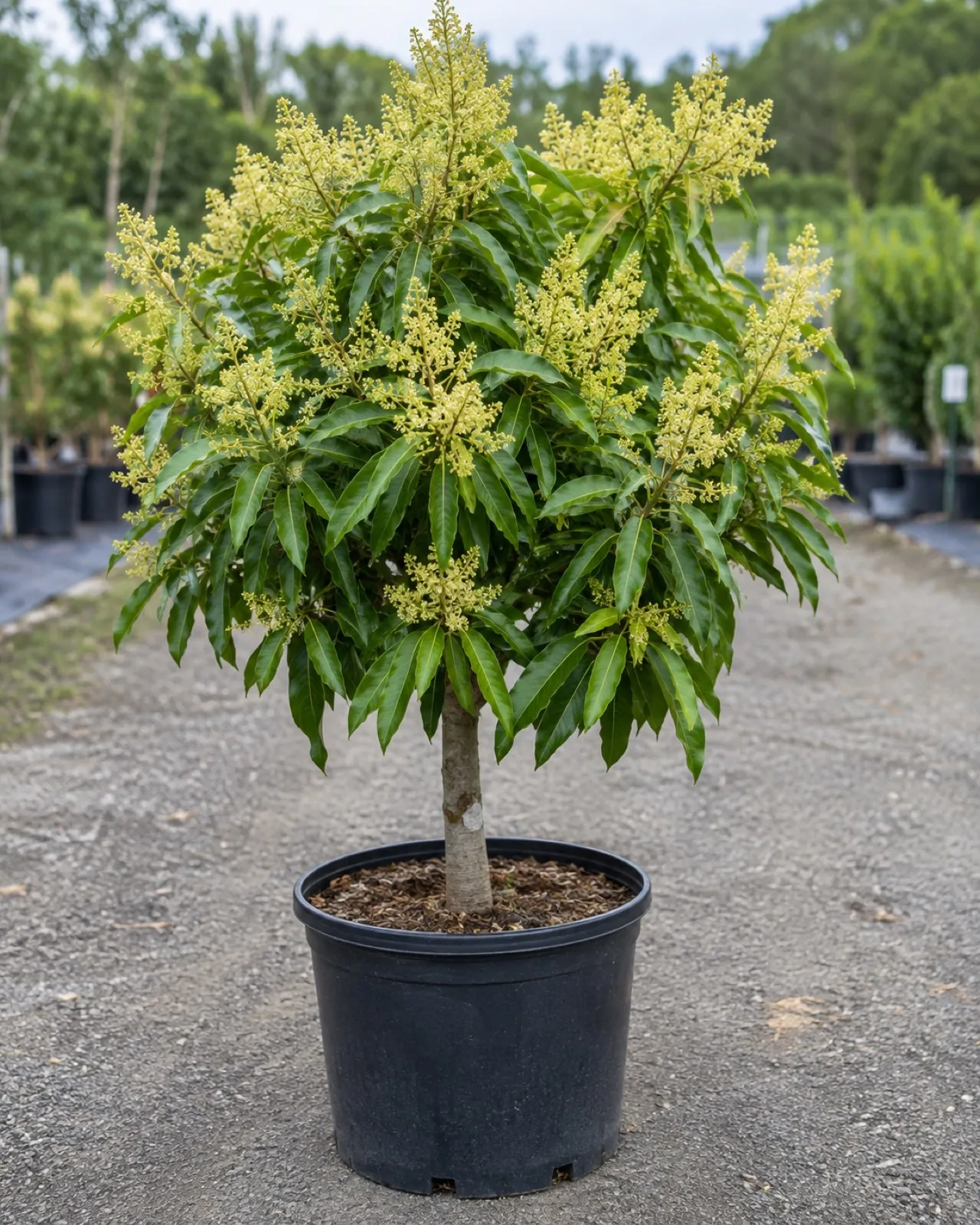
You bring home a three-foot grafted mango tree, plant it, and a few months later it’s covered in flowers, or worse, small green fruit. It feels like a win. It’s usually not. A young tree that flowers before it has the roots, trunk, and canopy to support a crop is spending stored energy it needs for growth, and every fruit it holds onto is energy it isn’t putting into becoming the tree that will feed you for the next twenty years.
Why a young tree flowers before it’s ready
Grafted mango trees are cuttings from mature, fruiting wood grafted onto young rootstock. That graft wood already “knows how” to flower; it doesn’t wait for the rest of the tree to catch up. So a two-year-old nursery tree in a three-gallon pot can throw a full flower panicle using the hormonal maturity of the scion, while the root system underneath it is still establishing. The tree isn’t confused. It’s just front-loaded: mature top growth on an immature root and trunk system that can’t yet support a full crop without being set back.
Stress amplifies it. A tree that’s pot-bound, underwatered, or going through a dry spell will sometimes flower precisely because it’s stressed. Flowering is partly a survival response, not only a sign of health. So “my new tree is already blooming” is not automatically good news; check the roots and watering before you celebrate.
Should you remove the flowers or the fruit?
Don’t strip flowers off the moment you see them. Mango panicles that are cut too early tend to trigger the tree to simply re-flower, which burns even more stored energy than letting the first flush run its course. That’s the opposite of what you want. The better move is patience with a deadline: let the flowers set fruit, and once that fruit is roughly marble-sized, cut the panicle off at its base.
At that stage you’re removing a known, small energy cost rather than gambling on a second or third re-flowering cycle. It also lets you see whether the tree can hold fruit at all; some young trees drop everything on their own before you’d need to intervene.
How aggressive to be depends on the tree’s condition, not a fixed age:
- Weak, recently planted, or root-bound tree: remove all fruit for the first year or two. One small crop can meaningfully slow canopy and root development you’ll want later.
- Vigorous, well-established young tree (planted a full growing season ago, visibly pushing new growth): letting it carry one or two fruit to ripeness usually does little harm and satisfies the temptation to taste it.
- Grafted tree still in a nursery pot, not yet in the ground: remove everything. It has no business fruiting before it’s even planted in its permanent spot.
Is your tree just a precocious variety?
Before you assume something’s wrong, check what you actually planted. Some mango varieties are bred or selected specifically to flower and fruit young. Growers call this trait “precocious,” and it’s a documented, named characteristic, not a fluke. Of the 346 varieties in Mango Atlas, we’ve flagged 7 whose profiles explicitly describe them as precocious bloomers, including Pickering, Amrapali, Saigon, and Nam Doc Mai #4, all naturally compact trees that were selected in part because they fruit early and reliably, even in containers.
The flip side matters just as much: varieties like Okrung and Peach Cobbler are documented as distinctly un-precocious, sometimes taking years to produce their first bloom even when fully grafted and well cared for. If your Okrung hasn’t flowered in year two, that’s not a problem. That’s the variety.
In other words, “too early” is relative to the variety. A Pickering fruiting in its second year in a pot is behaving exactly as bred. A large, vigorous variety like Keitt or Kent doing the same thing is more likely responding to graft maturity and stress than to being naturally early, and it’s also the tree more likely to benefit from you removing that first crop.
When it’s fine to let a young tree keep its fruit
There’s no universal “wait three years” rule, but a few signs suggest a tree can afford to carry fruit:
- It’s been in the ground at least one full growing season and has pushed multiple flushes of new leaf growth: evidence the root system is established, not just surviving.
- The flush is light, a handful of fruit rather than a heavy panicle-covered crop. A tree that sets fruit sparingly is telling you it has energy to spare.
- It’s a known precocious variety bred for early bearing, as above.
- You’re prepared to remove fruit anyway if the tree shows stress (leaf drop, wilting, or a stalled flush) partway through fruit development.
Grafted mango trees commonly start reliable bearing three to five years after planting under good conditions; anything earlier than that is a bonus the tree is paying for out of its own reserves, and it’s your call how much of that bill you want it to carry in year one versus year three.
If you’re not sure whether what you’re looking at is a flower panicle, a fruit set, or something else going on with the tree entirely (leaf curl, spotting, a stalled flush), the Mango Atlas scan feature is built for exactly that: photograph what you’re seeing and get help figuring out what stage the tree is actually in before you decide whether to prune it back.
Go deeper than any article
300+ variety profiles, your trees, your harvests, one app.