
How to Ripen and Store Mangoes at Home
Keep an unripe mango on the counter until it gives slightly under gentle pressure, then move it to the refrigerator, where the National Mango Board says whole ripe fruit keeps for up to five days. Cut mango goes in the fridge within two hours, or in the freezer for months. The most avoidable mistake is chilling an unripe mango too early.
This guide is the second half of our ripeness guide. That one covers how to tell when a mango is ready. This one covers what to do before, during, and after.
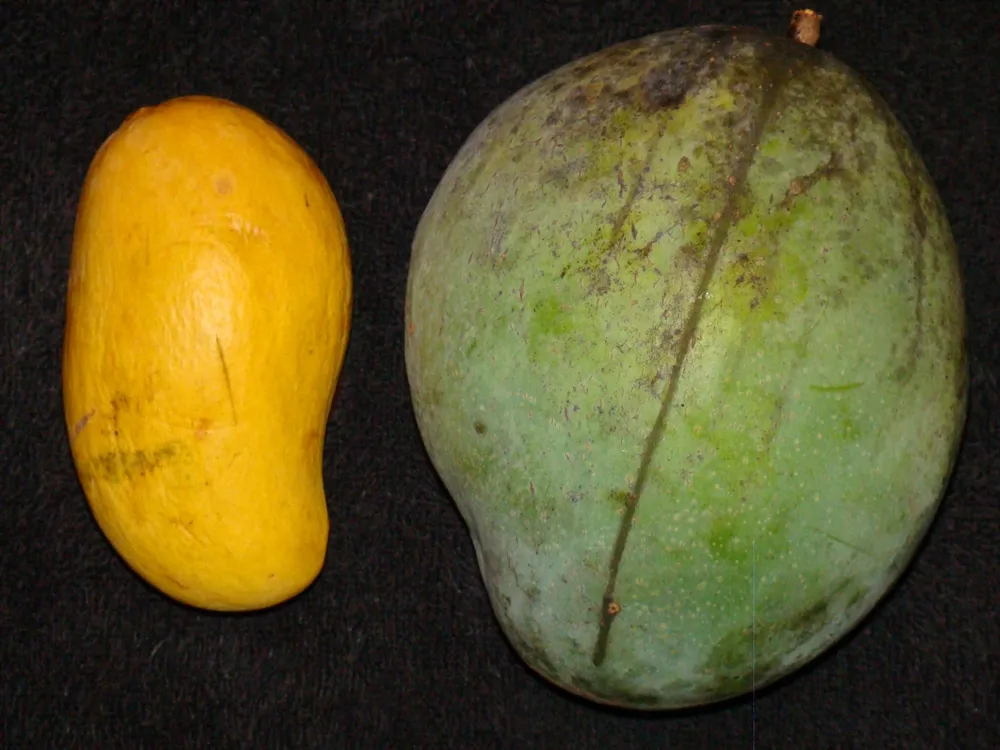
Ataulfo, left, beside a Keitt identified as ripe by the photographer. Photo: Asit K. Ghosh (Thaumaturgist), Wikimedia Commons, CC BY-SA 3.0. Unaltered.

How do you ripen a hard mango at home?
Leave it at room temperature and check it every day. The National Mango Board advises keeping unripe fruit out of the refrigerator so it can continue ripening naturally, getting sweeter and softer over a few days.
Temperature matters. In guidance from UF/IFAS postharvest researcher Jeffrey Brecht, as summarized by The Produce News, about 68 to 72°F promotes ripening, while around 55°F slows it down. A normal room sits in the first range.
To speed things up, put the mango in a paper bag at room temperature, as the National Mango Board suggests. Fold the top over loosely. Then check it daily, because a bagged mango can go from firm to soft faster than you expect.
How long does a mango take to ripen?
It varies. A UC Davis postharvest guide says most mangoes ripen within about 10 days at room temperature, and some sources describe four to five days. Treat both as ranges, not promises. Variety, how mature the fruit was when picked, and your room’s temperature all change the answer.
Fruit picked too early can also disappoint. A study of ‘Ubá’ mangoes in Brazil found that fruit harvested at the earliest stages did not ripen completely after picking. If a mango never softens and stays sour, early harvest is one possible reason.
How do you know when to stop waiting?
Use feel first. A ripe mango gives a little under gentle pressure, the way an avocado or peach does. Color is a weak guide, because some varieties stay green when ripe. Keitt and Carrie are the standard examples, while Tommy Atkins can look ripe from its red blush long before it is.
Mango Atlas has a skin-color record for 329 of its 346 varieties, and 88 of those 329 descriptions mention green. That is more than one in four records, which is why we say not to wait for yellow as a universal rule. These are descriptions of how a variety can look, not ripeness tests for an individual fruit. See the ripeness guide for the variety-by-variety comparison.
Should you put an unripe mango in the refrigerator?
No. This is the one rule worth remembering. Unripe mangoes are vulnerable to chilling injury, and a household refrigerator is colder than they like.
The National Mango Board’s chilling injury report says fruit stored below 50°F (10°C) can develop chilling injury and recommends about 54 to 55°F (12 to 13°C) for storage. Other researchers put the threshold slightly differently, between about 10 and 13°C depending on the source and the fruit’s maturity. So 50°F is a conservative rule of thumb, not a sharp line.
The board’s executive summary lists the symptoms: uneven ripening, poor color and flavor, surface pitting, grayish scald-like skin, and in severe cases browning of the flesh. The damage often doesn’t show until the fruit is back at room temperature, so a mango can look fine coming out of the fridge and ripen badly on the counter.
How do you store a ripe mango?
Once it is ripe, put the whole fruit in the refrigerator. The National Mango Board says whole ripe mangoes keep for up to five days there. Cold slows further ripening, which buys you time.
Very soft varieties deserve a shorter window. Ripe Carrie, for instance, is described by Tropical Acres Farms as extremely soft and easily bruised. Use fruit like that sooner and handle it gently.
If you have more ripe mangoes than you can eat in a few days, cut and freeze them instead of waiting for the fridge deadline.
How long does cut mango last?
Refrigerate cut mango promptly. The CDC’s food safety advice for cut fruit is to refrigerate within two hours, or within one hour if the temperature is above 90°F, at 40°F or colder. That guidance was written about pre-cut melon, but it is the general rule for cut produce.
Store the pieces in a clean, airtight container. We did not find an authoritative mango-specific figure for how many days cut fruit keeps in the fridge, and online estimates range from a few days to about a week. Eat it within a few days.
Can you freeze mango?
Yes. The National Mango Board says cut mango freezes for up to six months in an airtight container. Several food sites suggest a quicker, less sticky method: spread the pieces on a parchment-lined tray, freeze them until solid, then move them to a freezer bag.
Expect a softer texture after thawing. Frozen mango is better for smoothies, sauces, and purées than for slices you want to hold their shape. Six months is a quality window, not a safety cutoff.
Which varieties are easiest to handle?
Variety changes the details, not the rules. Ataulfo tends to wrinkle slightly when fully ripe, while Kent shows yellow undertones as it ripens. The National Mango Board’s variety profiles describe both. For any of them, the same sequence applies: ripen warm, check by feel, then chill.
A simple routine
- Start with firm, unripe mangoes.
- Leave them on the counter at normal room temperature, in a loosely folded paper bag if you want them sooner.
- Press gently every day. Move ripe fruit to the refrigerator.
- Use whole ripe fruit within about five days.
- Cut what you will not eat soon, and freeze it.
You can look up a variety’s usual texture and season in the Mango Atlas app to decide how carefully to watch it.
Go deeper than any article
300+ variety profiles, your trees, your harvests, one app.