Ataulfo, Honey, Champagne: One Mango, Three Names
Ataulfo, honey, and champagne mangoes are the same variety: a small, golden-yellow, nearly fiberless mango from Chiapas, Mexico. “Ataulfo” is the variety name. “Honey” is a US marketing name that the National Mango Board began promoting in 2017. “Champagne” is a brand that one importer built around Ataulfo fruit.
If you’ve stood in a grocery aisle wondering whether the honey mangoes and the champagne mangoes are two different things, they aren’t. Here is how the names piled up, and why a few other “honey” mangoes are not the same fruit at all.
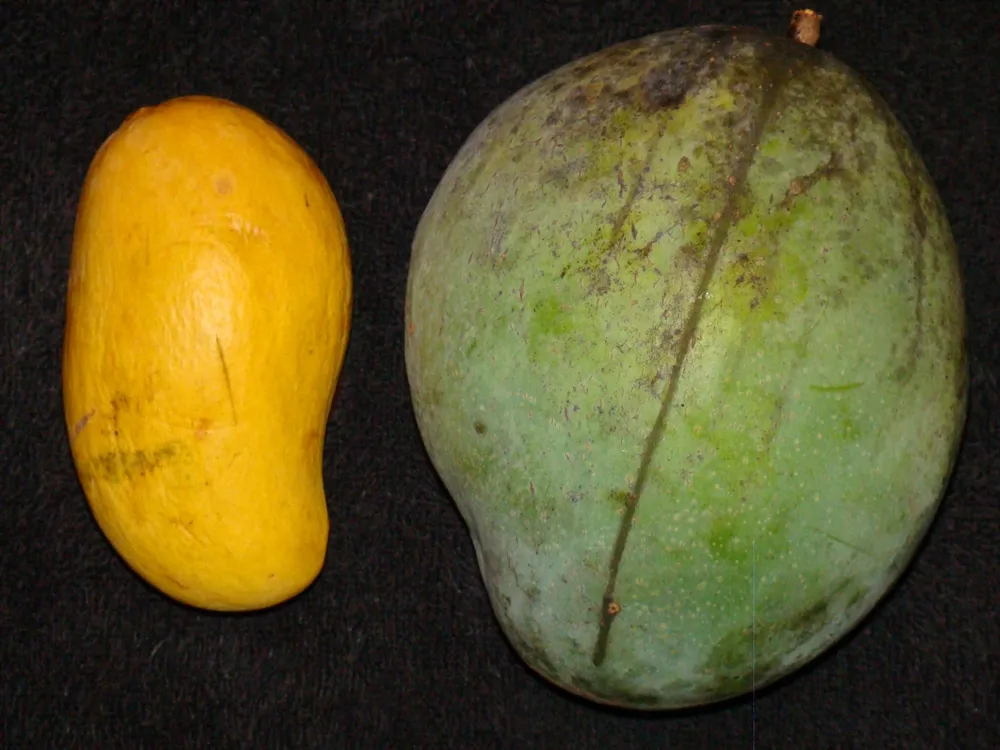
An Ataulfo (left) next to a Keitt, to show the size difference. The source identifies the Ataulfo as store-bought and the Keitt as ripe. Photo: Asit K. Ghosh (Thaumaturgist), Wikimedia Commons, CC BY-SA 3.0. Unaltered.

Are Ataulfo, honey, and champagne mangoes the same?
Yes. All three names point to the Ataulfo variety. In the Mango Atlas record for Ataulfo, “Honey mango” and “Champagne mango” are both listed as common names for the same fruit.
The one wrinkle is that the names do not mean exactly the same kind of thing:
- Ataulfo is the variety name, the one growers, researchers, and Mexican law use.
- Honey is a marketing name for the US market.
- Champagne is a brand name that applies to some Ataulfo fruit, not all of it.
Why is Ataulfo called a honey mango?
Because the National Mango Board decided the name was easier to sell. In March 2017 the Board announced a campaign to promote the variety in the US as “Honey,” saying the name Ataulfo was often mispronounced and that this created a barrier to purchase. The campaign was also meant to point at the fruit’s sweet taste and creamy texture. According to Fresh Fruit Portal’s coverage, the change did not alter USDA or PLU requirements, though shippers were encouraged to print “Honey” on their stickers.
Not everyone liked it. Fresh Fruit Portal reported that some in the Mexican industry objected, including a packers’ association said to have complained that growers were not consulted. The pushback is worth knowing about because it explains why you will still see both names on shelves: some sellers use “Ataulfo,” some use “Honey,” and some print both.
Is a champagne mango different from an Ataulfo?
A champagne mango is an Ataulfo sold under a brand. Specialty Produce describes Champagne® as a name coined by the Ciruli Brothers, an Arizona-based importer that began selling mangoes in the 1980s and wanted to set its fruit apart from other Mexican mangoes. Its summary is easy to remember: all Champagne mangoes are Ataulfo, but not all Ataulfo mangoes are Champagne.
We have not verified the current trademark registration, so treat “Champagne” as a brand name in use rather than a legal guarantee of anything about the fruit inside. If a box says Champagne, the fruit is Ataulfo. If a box says Ataulfo, it may or may not carry that brand.
Where does the Ataulfo name come from?
From Soconusco, a region of Chiapas in southern Mexico. Accounts differ on the details of who selected it and when (the surname of the grower honored in the name is given differently in different sources), but they agree on the region, and one account dates the selection to 1963. The variety is usually described as a descendant of the Philippine mango that reached Mexico on the Manila galleon trade, which is where a fourth name enters.
In 2003, Mexico adopted a declaration of protected origin, “Mango Ataulfo del Soconusco Chiapas,” which WIPO Lex lists as taking effect on August 28, 2003. Only fruit grown in the named Chiapas municipalities can carry that protected name. That is a protection for the origin name, and it does not mean an Ataulfo grown elsewhere is a different variety. Mango Atlas lists Ataulfo’s origin as Chiapas, Mexico, and notes it is grown commercially elsewhere in Latin America.
Is a Manila mango the same as an Ataulfo?
Not reliably. “Manila” is the confusing one. Ataulfo is thought to descend from the Manila group of mangoes, and in the US you will sometimes see the name “Manila” used loosely. But Manila is also a separate, older type, and at least one guide to Mexican markets lists Manila and Ataulfo as separate varieties.
Mango Atlas shows the overlap in its own data. The record for Philippine (Carabao), described in our data as the most popular mango in the Philippines, lists “Manila” as a common name, while Ataulfo does not. If a label says Manila, don’t assume Ataulfo.
What makes an Ataulfo different from other yellow mangoes?
Size, texture, and a very low fiber rating. Our data records Ataulfo as a small, oblong, yellow fruit with golden-yellow flesh, firm but fiberless, with a mild, subacid flavor that sweetens as the fruit ripens and the skin wrinkles. If you want the full picture of why that texture is unusual, see our guide to mango fiber.
That wrinkling is the detail that trips up shoppers. A slightly wrinkled Ataulfo is not necessarily overripe, which we cover in how to tell if a mango is ripe.
Season depends on where the fruit is grown. Sources vary on the Mexican window, with peaks in roughly spring into early summer, so expect the exact timing to shift by region and year. Mango Atlas’s farm notes record it as a mid-season mango ripening from late June into July in Florida.
Are other “honey” mangoes the same as Ataulfo?
No, and this is where the name causes real confusion. “Honey” shows up in the names or common names of four varieties in Mango Atlas, and only one of them is the Ataulfo you find in the grocery store.
| Mango Atlas record | Where “honey” appears | Fiber rating |
|---|---|---|
| Ataulfo | “Honey mango” (common name) | Very Low |
| Honey Kiss | Part of the variety name | Low |
| Shwehintha | “Raw Honey” (common name) | Very Low |
| Zill 3-18 (‘Honey’) | Name in parentheses | Medium |
Honey Kiss is a Florida variety. Our record describes it as a Keitt seedling from the Zill breeding program, and it ripens late, from late July into August in West Palm Beach, rather than in Ataulfo’s season there. It has nothing to do with the Ataulfo’s origin, and it is not the same fruit. Zill 3-18 was a selection that our record says was briefly called “Honey” many years ago but hasn’t been propagated under that name.
Separately, 16 of the 346 varieties in Mango Atlas mention honey in their flavor profile or flavor notes. That is a taste descriptor, not a name, and it applies to many Thai-type varieties as well. So when you see “honey” on a tag, check for the word Ataulfo, or the grower’s variety name, before assuming anything about size or fiber.
How can you be sure you’re buying an Ataulfo?
Look for the small size and the golden-yellow skin, and read the label for any of the three names. A mango that is large, green, or red-blushed is not an Ataulfo, whatever the sticker says. If you’re comparing fruit in the store, check the variety against its profile in Mango Atlas, where Ataulfo’s size, fiber, texture, and flavor are listed side by side with the other 345 varieties.
The short version
Same mango, three labels: Ataulfo is the variety, Honey is the US marketing name, and Champagne is a brand. Manila is a relative, not a synonym, and mangoes with “honey” in other names are different fruit. For a sense of how different a big mango looks, compare the Ataulfo with a Keitt or a Kent, two larger varieties that look nothing like it.
Go deeper than any article
300+ variety profiles, your trees, your harvests, one app.